

Key Takeaways
- The distinction – Partial knee replacement is almost exclusively used to treat arthritis limited to one compartment of the knee, while a total arthroplasty can address various forms of damage affecting multiple areas of the joint.
- Determining factors – Your symptoms and long-term goals are considered alongside the location and severity of joint degeneration, ligament stability, and joint alignment, which are assessed using imaging and physical exams.
- Recovery differences – Total knee replacements usually require more rehabilitation than partial ones, but robotic technology can support recovery for both procedures by promoting precise planning and implant positioning.
Why There Isn’t a One-Size-Fits-All Answer
The suitability of a partial vs total knee replacement is dependent on what is happening inside the patient’s knee.
The knee is made up of three primary compartments: the medial compartment on the inner side, the lateral compartment on the outer side, and the patellofemoral compartment between the kneecap and thighbone. Arthritis, which is the most common reason people get knee replacement surgery, can affect one compartment, multiple compartments, or the entire joint.
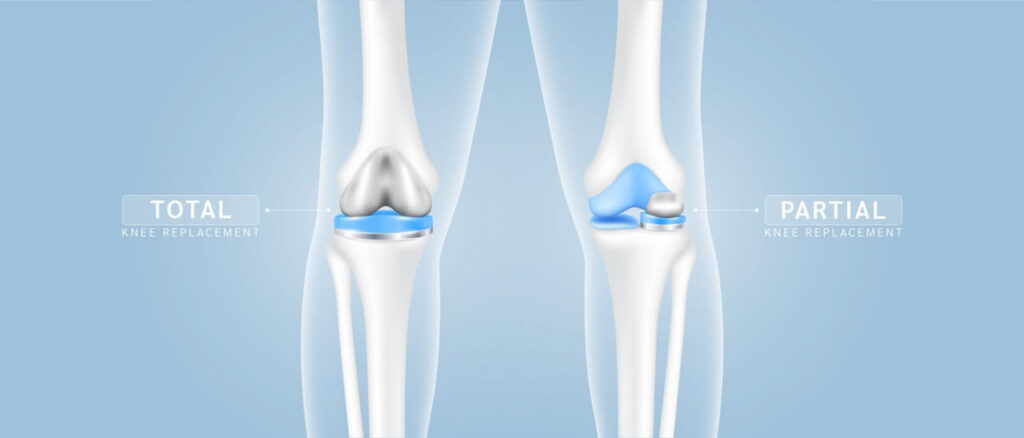
As its name suggests, partial/unicompartmental knee replacement only addresses an isolated damaged portion of the knee while attempting to preserve the remaining healthy compartments. On the other hand, a total knee replacement replaces all three compartments of the joint.
Your surgical team will have the clearest answer as to which operation will appropriately address your underlying joint complications while preserving as many healthy structures as possible. Nevertheless, the guide below can help you understand what goes into their decision, as surgeons must consider factors beyond cartilage damage, including ligament integrity, alignment, bone quality, range of motion, and more.
What Is the Difference Between Partial and Total Knee Replacement?
Partial knee replacement replaces only the damaged compartment of the knee, while total knee replacement replaces the damaged surfaces across the entire knee joint. The right procedure depends on various factors, from the patient’s anatomy and arthritis pattern to their knee stability and alignment.
One of the main disadvantages of partial knee replacement is that it is usually only appropriate when arthritis is limited to one compartment and the rest of the knee remains healthy. In contrast, total replacement is generally considered when arthritis or another joint condition affects multiple compartments.
What Surgeons Look for Before Recommending a Procedure
Determining whether someone is a candidate for partial or total knee replacement requires a comprehensive evaluation. In most cases, advanced imaging and in-person physical examinations are used to gauge determining factors like:
- The location and extent of arthritis – If significant arthritis is isolated to one compartment, a partial replacement may be an option. When arthritis affects multiple compartments, total replacement is usually more appropriate.
- Ligament integrity – The condition of the knee’s supporting ligaments can also matter. Partial knee replacement generally requires adequate ligament function because more of the patient’s native knee remains in place.
- Alignment and stability – The surgeon evaluates how the knee is aligned and checks how it behaves during movement. Significant deformity or instability may demand total knee replacement to increase the likelihood of restoring proper function.
Imaging gives insight into your intricate joint mechanics, and physical examinations allow surgeons to assess your range of motion, tenderness, stability, and alignment. However, the information you provide during your first orthopedic consultation also plays a role.
Symptoms, Functional Limits, and Long-Term Goals
The level of pain and stiffness you feel and communicate to your surgical team is also taken into account. Your surgeon will likely ask about activity limitations to get an idea of how your joint condition is affecting your everyday life. Maybe you are a golfer who has had trouble playing the sport and are interested in getting back into golf after knee replacement surgery—regardless of what interests you, your long-term goals matter.
Even if two patients have similar-looking X-rays, they may experience their arthritis very differently and have unique post-surgery goals, causing them to receive different recommendations as a result. This is why candidacy cannot be determined from an imaging report alone. A surgeon needs to consider the complete clinical picture before recommending continued conservative treatment, partial replacement, or total replacement.
When a Partial Knee Replacement Makes Sense
Partial knee replacement is generally considered when arthritis is limited primarily to one compartment of the knee and the remaining structures are healthy enough to preserve. In rare situations, partial knee replacement may also be used to address other complications aside from arthritis, such as:
- Localized Post-Traumatic Damage – If the destruction caused by a past physical injury or fracture is confined to one side of the knee, partial knee replacement may be appropriate, but this is unlikely.
- Avascular necrosis – Death of bone tissue that is strictly limited to a single portion of the thigh or shin bone may only affect one compartment of the knee, potentially making partial knee replacement appropriate.
- Focal osteochondral defects – Localized cartilage or bone lesions that have not responded properly to conservative care or biological repair methods may qualify for partial knee replacement if the rest of the joint is healthy.
Pros and Cons of Partial Knee Replacement
For appropriately selected patients, preserving healthy portions of the knee can offer several potential advantages. The most noteworthy is that many patients experience a more natural-feeling knee after partial replacement because more of the original bone, cartilage, and ligaments remain intact.
The main disadvantages of partial knee replacement are tied to its more limited scope. Because only the damaged compartment is replaced, the remaining portions of the knee must be healthy enough to function appropriately.
If arthritis later develops or progresses in another compartment, you may need to get a second replacement that addresses the additional joint degeneration. Partial replacement also requires careful patient selection, and not every knee with arthritis can be appropriately treated with this approach.
For this reason, choosing a partial replacement simply because it preserves more of the natural knee is not necessarily appropriate. The procedure must match the actual pattern of disease.
When Total Knee Replacement Becomes the Better Option
Total knee replacement is usually recommended when joint degeneration has affected at least two of the three knee compartments. Patients with widespread knee arthritis or an extensive injury often need the damaged portions of the femur, tibia, and patella resurfaced, rendering total knee replacement a more comprehensive solution in most of those scenarios.
Does Needing a Total Knee Replacement Mean My Condition Is Worse?
No, a recommendation for total knee replacement does not necessarily mean that a patient’s knee is worse than someone’s who was recommended a partial knee replacement. It simply means the pattern or extent of joint disease may require a procedure capable of addressing more of the affected joint. The distinction is important because the best procedure is determined by the anatomy and disease pattern, not by how extensive the operation sounds.
Robotic Technology’s Role in Both Procedures
Robotic-assisted surgical technology like Mako SmartRobotics™ and the CORI Surgical System can be used during both partial and total knee replacement, if the surgical facility is trained and equipped to use it. The technology does not determine which procedure a patient needs; that is up to the surgeon. However, the technology can support the surgeon after the appropriate procedure has been selected.
What Is Robotic Technology Used For?
Depending on the robotic platform and procedure, surgeons can use patient-specific imaging and digital planning to evaluate anatomy before surgery. The plan may account for factors such as implant sizing, implant positioning, bone preparation, alignment, and joint balancing.
During surgery, robotic systems can provide additional measurements and guidance as the surgeon prepares the joint and positions the implant. The added level of precision can result in shorter recovery times for Mako knee replacements and similar robotic-assisted procedures.
Does the Robot Perform the Surgery by Itself?
No, the robotic system does not independently diagnose the patient’s condition, select the procedure, or perform the operation without the surgeon—the trained medical professional remains in complete control throughout the procedure.
Nevertheless, the technology supports the surgical process for both partial and total replacement, allowing the surgeon to work from an individualized plan while using intraoperative information to make appropriate adjustments.

Recovery After Partial vs. Total Knee Replacement
Recovery is one of the areas patients focus on the most when researching partial vs total knee replacement, and rightfully so; it is important to know what to expect during knee replacement physical therapy and while healing in general.
The table below breaks down the various aspects of recovery to help you further understand the difference between partial and total knee replacement.
| Recovery Factor | Total Knee Replacement | Partial Knee Replacement |
| Extent of surgery | Resurfaces more of the knee joint | Replaces only the damaged portion of the knee |
| Rehabilitation | Typically requires structured rehabilitation to restore strength, mobility, balance, and function | May involve a shorter or less intensive rehabilitation process for some patients |
| Postoperative discomfort | May involve more discomfort during the early recovery period | May involve less postoperative discomfort for some appropriately selected patients |
| Mobility | Mobility typically improves progressively as the knee heals and strength returns | Some patients may regain mobility sooner |
| Return to activities | Activities are typically resumed gradually as recovery progresses | Some patients may return to certain activities more quickly |
Although partial replacement can involve a shorter or less intensive recovery for some appropriately selected patients, partial vs total knee replacement shouldn’t be chosen based on which has the fastest theoretical recovery—the focus should be on which procedure best fits the patient’s condition. Opting for a faster recovery at the expense of adequately addressing the underlying arthritis can cause the patient to require knee revision surgery later down the line.
Lean On Your Surgeon for Advice
Patients should not feel that they need to decide between the procedures on their own. A dependable surgical practice should be able to explain why a particular operation is being recommended and what findings make another option less appropriate.
Questions worth asking include:
- How many compartments of my knee are affected by arthritis?
- Are my ligaments healthy enough for a partial replacement?
- How does my knee alignment affect the surgical plan?
- What are the expected benefits and limitations of each option for my condition?
- What will my rehabilitation involve?
- How might robotic technology be used during my procedure?
These questions can help you get a better understanding of why your surgeon is recommending a partial or total replacement.
Matching the Procedure to the Patient
The decision between partial and total knee replacement ultimately comes down to matching the operation to the patient’s anatomy, including aspects like their arthritis pattern and knee stability, along with their symptoms and long-term goals.
Understanding the reasoning behind the recommendation can be more valuable than focusing on whether one procedure sounds more advanced, less invasive, or faster to recover from.
At The Joint Replacement Center of Scottsdale, treatment planning is based on each patient’s anatomy, condition, activity level, and recovery goals. If you are considering knee replacement and want to understand whether partial or total replacement is appropriate for you, Dr. Shane Martin and our other team members will happily discuss treatment options with you.
Contact the Joint Replacement Center of Scottsdale to schedule a consultation and get the clarity you are looking for.