

Executive Summary
- Clicking after knee replacement surgery is a relatively common experience and is often related to the way artificial joint components move during daily activities.
- Knee replacement clicking is usually considered harmless when it occurs without pain, swelling, instability, or loss of function.
- In many cases, the clicking in a knee replacement will gradually decrease or completely go away as swelling subsides and the surrounding muscles strengthen.
- Working with a medical professional like a licensed physical therapist to rebuild muscle and improve movement patterns can help patients recover with greater confidence.
Why Your New Knee May Sound Different
To many people’s surprise, clicking after knee replacement surgery is fairly common. Many patients describe a clicking, popping, tapping, or clunking inside the knee during certain activities, most notably walking, standing up from a chair, climbing stairs, or changing positions in bed. While unusual noises and sensations can understandably raise concerns, it is important to know that some degree of knee replacement clicking is often expected.
A natural knee joint features cartilage-covered surfaces that reduce friction, while modern-day knee replacements are usually made out of metal and plastic. Although these prostheses are carefully designed to restore function and relieve pain, they are bound to move differently than natural tissue. As a result, they can sometimes produce sounds that patients notice during everyday activities.
Don’t worry, in many cases, the sound itself is not a sign that something is wrong—a well-functioning knee replacement can still click occasionally. Plus, the clicking in your knee replacement may go away or decrease over time.
The guide below can help you understand why your knee replacement clicks and when sensations are considered normal so you can feel more confident as you continue your recovery journey.
How Common is Noise Generation After Modern Knee Replacements?
Roughly 27% of patients report experiencing grinding, popping, or clicking noises from their artificial knee in the months following surgery. Sometimes, the clicking in a knee replacement will go away or fade, but even if you still notice occasional clicking, there is a good chance that it is normal and something that you will adapt to as you learn how to function with your new artificial knee, assuming there aren’t other issues like pain or restricted mobility that accompany the noise.
Learning About the Nuances of an Artificial Joint
To understand knee replacement clicking, it helps to understand how an artificial knee differs from the original joint.
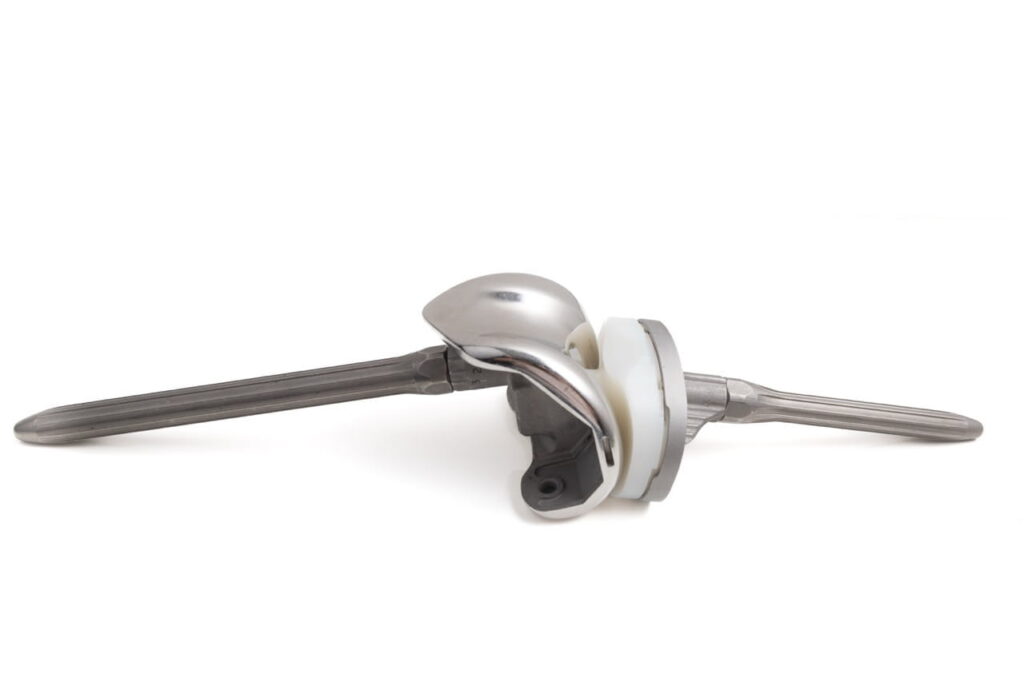
A knee replacement typically consists of metal components attached to the ends of the thighbone and shinbone, along with a durable plastic spacer positioned between them. These materials are designed to move smoothly and restore function, but they do not behave exactly like natural cartilage and tissue.
What’s Actually Creating the Click?
As the knee bends and straightens, the implant components interact with one another in a predictable mechanical way. This movement can sometimes create audible clicking or popping sounds.
However, the implant itself may not be the only source of the noise—the structures surrounding the knee also continue to adapt after surgery, and they may be the culprit. Some examples of bodily structures that interact with the new joint during movement are:
- Tendons
- Ligaments
- Muscles
- Scar tissue
As these soft tissues glide over changing surfaces and adjust to the knee’s new alignment, they can contribute to sensations and sounds that patients notice.
Other Factors That Contribute to Knee Replacement Clicking
Aside from the implant’s metal components and plastic spacer and bodily structures like tendons, ligaments, and scar tissue, the two most common reasons why someone’s knee replacement clicks are:
- Muscle weakness – If the quadriceps and the hamstrings have atrophied during the more sedentary stages of recovery, you may have less control around the joint, contributing to knee replacement clicks.
- Swelling – Inflammation causes temporary changes in joint mechanics that can make popping or clicking sensations more common and more noticeable.
Therefore, these sounds are often most noticeable during the first several months after surgery. During this period, your body is still adapting to the new joint. As your recovery progresses and you strengthen your muscles and reduce swelling after knee surgery, you may become less aware of these sensations. Still, there is no guarantee that the clicking in your knee replacement will go away entirely.
When Is Knee Replacement Clicking Considered Normal?
Clicking after knee replacement surgery is often considered a normal part of recovery and long-term joint function when it occurs without other symptoms. A knee that clicks occasionally but remains stable, functional, and comfortable is often behaving exactly as expected. Still, if you have concerns, you should talk to an experienced medical provider like Dr. Shane Martin for assurance and peace of mind.
When Is Knee Replacement Clicking Most Common?
Patients commonly notice clicking during activities such as:
- Standing up from a chair – The increased joint movement and muscle activation can cause components to interact in a way that creates audible noises.
- Walking – The repetitive bending and straightening motions can trigger knee replacement clicks, especially if you are turning while walking.
- Climbing stairs – While climbing stairs, the joint is subjected to a greater level of force that can lead to clicking.
- Getting into bed – As you change positions, rotational movements can cause bodily structures and the artificial joint components to slide in a manner that makes noise.
- Squatting – Increased contact between joint components can also cause clicking.
Many people find that the sounds become more noticeable when they are paying close attention to the knee. During early recovery, patients are often highly aware of every sensation because the joint still feels unfamiliar.
Clicking Does Not Always Need Further Intervention
Even after successful surgery, the knee may never feel exactly like the natural joint it replaced. It may move differently, feel different during certain activities, and occasionally produce sounds that were not present before surgery—this does not necessarily indicate a problem.
The important distinction is whether the clicking occurs by itself or whether it is accompanied by symptoms that suggest something more significant may be occurring. For example, knee pain when sitting or squatting is typically much more worrisome than solely hearing clicking sounds while performing the same motions.

The Symptoms That Matter More Than the Noise
Since surgeons are usually more interested in accompanying symptoms than the sound itself when evaluating clicking after knee replacement, patients should pay attention to how the knee feels during and after activity.
Six symptoms that may indicate that additional evaluation is appropriate are:
- Pain
- Swelling
- Instability
- Catching or locking
- Reduced mobility
- Sudden changes in symptoms
So if you notice occasional subtle clicks while climbing stairs after a knee replacement but have no pain, swelling, or instability, you may not need follow-up care, but you can still contact your care team for peace of mind. On the other hand, someone whose clicking is accompanied by a sensation that the knee is giving way should schedule an evaluation immediately. Similarly, new symptoms that develop months or years after surgery deserve attention, even if the patient has experienced clicking before.
Why Some Patients Notice Clicking Longer Than Others
One reason patients often compare experiences online is that recovery timelines can vary dramatically. The recovery time for a Mako robotic-assisted knee replacement may be shorter than a traditional, more invasive arthroplasty, and it can potentially lead to less clicking due to less soft-tissue irritation.
In addition to the surgical approach, some other factors that can influence how the knee feels and functions during recovery include:
- Muscle strength – Building strong stabilizing muscles around the joint can improve control and progressively reduce clicking.
- Swelling levels – The inflammation levels of your knee can affect movement mechanics and fuel popping sensations for longer periods of time.
- Body mechanics – The way you walk and interact with your new joint influences how forces move through the knee and what may result in a clicking sound.
- Activity level – How physically active you are affects joint demands, and too much force on your new joints can lead to knee replacement clicks.
- Scar tissue adaptation – One of the most important things you need to know about knee replacement scars is that they can change sensation in that area over time.
Additionally, psychological factors may play a role in recovery. Early in recovery, some patients monitor every sensation closely due to anxiety and concern about protecting the new joint. As confidence improves and daily activities become easier, attention often shifts away from minor noises.
Many individuals stop noticing clicking within a few months, but others may continue to hear occasional sounds years after surgery.
How to Reduce Clicking Sensations
While it may not be possible to eliminate every sound, improving strength and movement quality can sometimes reduce awareness of mechanical sensations.
Physical therapy can enhance long-term joint health and optimize knee function after surgery. Through rehabilitation, you can build strong muscles that help stabilize the joint and support smoother movement patterns as you perform daily activities.
Some things you can expect during post-knee replacement physical therapy are:
- Quadriceps strengthening to improve knee control
- Hamstring strengthening to support balanced movement
- Hip strengthening to enhance lower-body stability
- Balance training to improve coordination
- Flexibility work to promote efficient movement
- Focusing on walking mechanics to reduce compensatory patterns
Patients who continue appropriate strengthening and conditioning often report feeling more comfortable during everyday activities.
Maintain Realistic Expectations
Eliminating every sound is not necessarily a realistic or medically necessary outcome. The three main goals of knee replacement surgery are:
- Improve function
- Reduce pain
- Enhance quality of life
Many patients achieve excellent long-term results even if occasional clicking remains present—the key measure of success is often how well the knee functions rather than how quiet it is.
Knowing When to Follow Up
Clicking after knee replacement is often a normal part of recovery, but there are situations where additional evaluation is appropriate. Patients should pay particular attention to clicking that is new, worsening, or noticeably different from what they have previously experienced. Likewise, if you have difficulty performing everyday activities due to increasing pain, swelling, instability, catching, or locking, consult a healthcare provider.
The team at the Joint Replacement Center of Scottsdale offers guidance to their patients from their very first orthopedic consultation all the way through recovery, so they know exactly what to expect for knee replacement clicking and beyond. Plus, we offer minimally invasive knee replacement surgery to minimize tissue irritation, which may reduce the chances of clicking after knee replacement.
Contact the Joint Replacement Center of Scottsdale today to schedule a consultation; our team is ready to give you a personalized evaluation and recovery guidance.