

Key Takeaways
- What can cause it – Knee pain while sitting may be due to conditions like patellofemoral pain syndrome or arthritis. The location and pattern of the pain can be clues, but symptoms alone cannot determine the underlying problem.
- How you may solve it – Changing positions, taking regular movement breaks, and gradually returning to activity may help with occasional pain and stiffness, but recurring pain likely needs its underlying cause to be addressed.
- When to seek help – Persistent or worsening pain, swelling, instability, locking, or loss of motion should be evaluated by an orthopedic professional to determine whether treatment is needed.
Why You May Feel Knee Pain after Sitting with Legs Bent
Underlying conditions like arthritis may be to blame for stiffness and knee pain while sitting, but this problem can affect ailment-free individuals too. In general, bending the knee for an extended period can restrict fluid movement and increase pressure within the joint by keeping the kneecap pressed against the thigh bone.
A study from the School of Health Sciences at the University of Sydney, Australia, showed that most healthy adults feel knee stiffness after sitting in one place for 30 minutes, with an increase in knee pain after sitting for 60 minutes. Despite the pervasiveness of this problem, occasional stiffness that improves after moving around is different from pain that consistently returns, becomes more intense, limits your activities, or continues after you get up.
The guide below can help you identify patterns associated with common causes of varying severity, from arthritis to patellofemoral pain syndrome and patellar tendinitis, which are known as runner’s knee and jumper’s knee, respectively. It also offers potential solutions for knee pain after sitting too long. Nevertheless, talking to a qualified medical provider is ideal to get clarity on your specific situation.
Where You Feel the Pain Can Offer Clues
The table below illustrates how pain location may correlate to certain conditions, though there is no guarantee that your situation follows the same pattern.
| Pain Location | Noteworthy Potential Causes | What You May Notice |
| Front of the knee (around or behind the kneecap) | • Patellofemoral pain syndrome • Patellar tendinitis • Bursitis • Cartilage problems | Discomfort may increase after keeping the knee bent for a prolonged period. You may also notice pain when standing up, climbing stairs, squatting, or repeatedly bending the knee. |
| Along the knee joint line | • Meniscus tear • Osteoarthritis • Other cartilage-related problems | Symptoms may include stiffness, swelling, catching, or a sensation that the knee is not moving smoothly. |
| Around the tendons or other soft tissues | • Tendinitis • Tendon irritation • Bursitis • Muscle-related problems | The area may be tender to pressure or become more noticeable when the affected tissue is used or stretched. |
| Behind the knee | • Baker’s cyst • Hamstring or calf tendon problems • Arthritis | You may notice tightness, fullness, or a feeling of pressure. Some conditions can also cause swelling or stiffness that changes throughout the day. |
How the Pain Feels Matters Too
The quality of the pain can provide additional clues. For example, a sharp pain that occurs with a specific movement may point toward an irritated or injured structure. In the same way, there is a link between arthritis and joint pain that is deep and achy.
However, location and sensation alone cannot establish a diagnosis. Since knee pain while sitting can be the result of injuries, arthritis, mechanical problems, or conditions affecting tissues around the joint, recurring symptoms should be evaluated in context—talking one-on-one with a trained joint specialist like Dr. Shane Martin is highly recommended.
Sitting Position Changes How Your Knee Feels
Sitting with the knee deeply bent for an extended period may be uncomfortable for some people, particularly when the front of the knee is already sensitive. Low chairs, deep couches, and other seating that keeps your knees in a more flexed position can make getting up more uncomfortable.
If a particular position consistently aggravates your knee, consider changing positions periodically rather than remaining still for an extended period—standing up, walking briefly, or gently moving the knee can help you transition out of a prolonged seated position. You may also find that a chair that allows you to sit at a comfortable height makes standing easier than a very low or deep seat.
The goal is not to avoid sitting or movement altogether. Instead, pay attention to positions that repeatedly trigger symptoms so you can explain your knee pain when sitting or squatting to your medical provider and adjust your routine, when possible.

The Difference Between Stiffness and a Bigger Knee Problem
Mild stiffness after sitting can happen even when there is no major structural problem, simply due to the pressure buildup that occurs when your knee is bent for too long. If your knee feels stiff when you first stand but loosens as you move, the symptom may not be as significant as pain that persists throughout the day or repeatedly interferes with normal activities.
Since the broader pattern is important, you should pay attention to whether you also experience things like:
- Swelling around the knee
- Clicking or grinding sensations
- Catching, locking, or a feeling that the knee is unstable
- Difficulty fully bending or straightening the knee
- Pain that occurs even when you are resting
- Increasing difficulty of everyday activities like walking up stairs
These symptoms do not necessarily point to one specific diagnosis, but they provide additional information for your healthcare provider. A change from your usual baseline can also be more meaningful than the amount of time you spent sitting.
Your Daily Routine Can Contribute to Knee Pain
Knee pain after sitting too long is not always caused by the act of sitting alone. The amount and type of activity you do before and after periods of sitting can also influence how your knee feels.
Pay Attention to What You Do Before Sitting
Spending several hours seated and then suddenly doing a demanding activity can place very different demands on the joint than alternating periods of sitting with regular, moderate movement. For example, sitting at a desk for most of the day and then immediately performing a strenuous workout like cycling may lead to knee pain, whereas gradually transitioning from sitting to walking and then a more demanding activity like cycling can feel smoother. Your overall activity pattern may therefore be worth considering alongside how long you sit.
Try keeping a relatively consistent level of movement throughout the day, rather than alternating between prolonged inactivity and sudden bursts of strenuous activity; it may make it easier to identify what aggravates your knee. This does not mean that everyone with knee pain needs to exercise more, though joint mobility exercises can be helpful. If a particular activity consistently causes pain, swelling, or instability, modifying the activity and discussing the symptoms with a healthcare professional may be more appropriate than putting more physical activity on your plate.
What You Do After Sitting May Also Play a Role
If your knee becomes uncomfortable after remaining seated, avoid immediately placing it under a demanding load. Instead, you may find it beneficial to move the joint through this brief five-step transition:
- Carefully straighten your knee gradually
- Gently move it through its natural range of motion
- Take a few well-calculated steps
- Do a body scan to assess comfort levels
- If it feels appropriate, slowly move to more strenuous activity
Changing positions throughout the day can also help prevent long periods of uninterrupted inactivity. Short movement breaks may be particularly practical during work, travel, or other situations where you spend a lot of time sitting.
If muscle weakness or limited flexibility contributes to your symptoms, physical therapy may be best for your long-term health. Strengthening the muscles around the knee can improve stability, but the right exercises depend on what is causing the pain. For that reason, avoid assuming that a particular exercise routine is appropriate simply because it helped someone else. A knowledgeable healthcare team can help determine which movements are appropriate for your symptoms and activity level.
Recurring Pain Shouldn’t Be Ignored
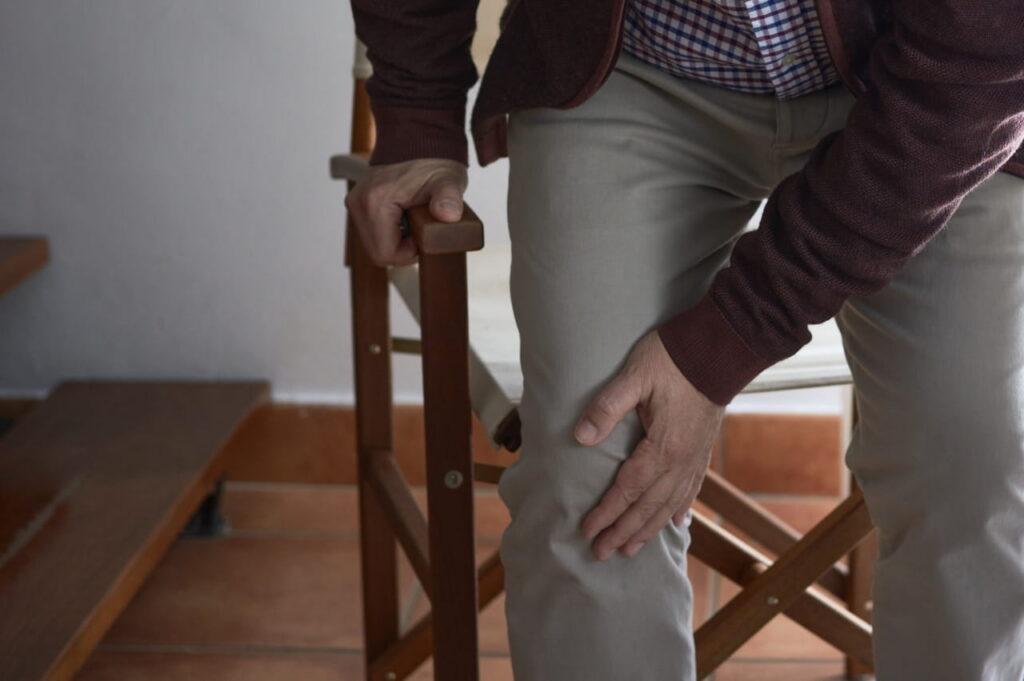
Again, occasional stiffness after sitting may not always require an extensive evaluation if it resolves quickly and does not interfere with the person’s normal activities. However, if you have knee pain after sitting that recurs frequently, gradually worsens, or limits your daily activities, you should consult a healthcare provider for proper assessment.
An evaluation is particularly important if your knee pain from sitting is accompanied by other symptoms like:
- Significant swelling
- Instability or an inability to bear weight
- Locking
- Substantial loss of motion
- Severe pain
A fever combined with redness, pain, and swelling can also require prompt medical attention.
What to Expect After Contacting a Professional
People with knee pain after sitting too long usually have an orthopedic consultation that begins with a discussion of their symptoms and medical history, followed by a physical examination. The healthcare provider may assess factors like:
- Swelling
- Tenderness
- Range of motion
- Strength
- Stability
- How you move
Depending on the suspected cause, imaging may also be appropriate. X-rays can help identify bone and degenerative changes, while MRI can provide more detailed information about cartilage, tendons, ligaments, muscles, and other soft tissues.
The goal is to determine what is actually causing your symptoms. Treatment for occasional stiffness can be very different from what you have to do for knee arthritis, a meniscus problem, tendon irritation, or another structural condition.
Finding the Right Solution Starts With the Cause
It is important to remember that knee discomfort after sitting does not automatically mean something is seriously wrong—a knee can become temporarily stiff after remaining in one position, particularly when it has been bent for an extended period. However, recurring pain, worsening symptoms, or changes in your ability to walk and move deserve closer attention.
The appropriate solution depends on the underlying cause. Treatment may include changing activities or sitting habits, physical therapy, medications, injections, or knee replacement surgery when a structural problem is severe enough to warrant it. For conditions such as knee osteoarthritis, treatment is generally selected according to the severity of symptoms and their effect on daily function.
If you regularly experience knee pain while sitting, pain when standing after sitting, or discomfort that continues after you get up, the Joint Replacement Center of Scottsdale can give you an orthopedic evaluation to help clarify what is happening.
Contact us to discuss your symptoms and determine whether further evaluation may be appropriate for your knee.